Friday, November 20, 2009

Visual Diff

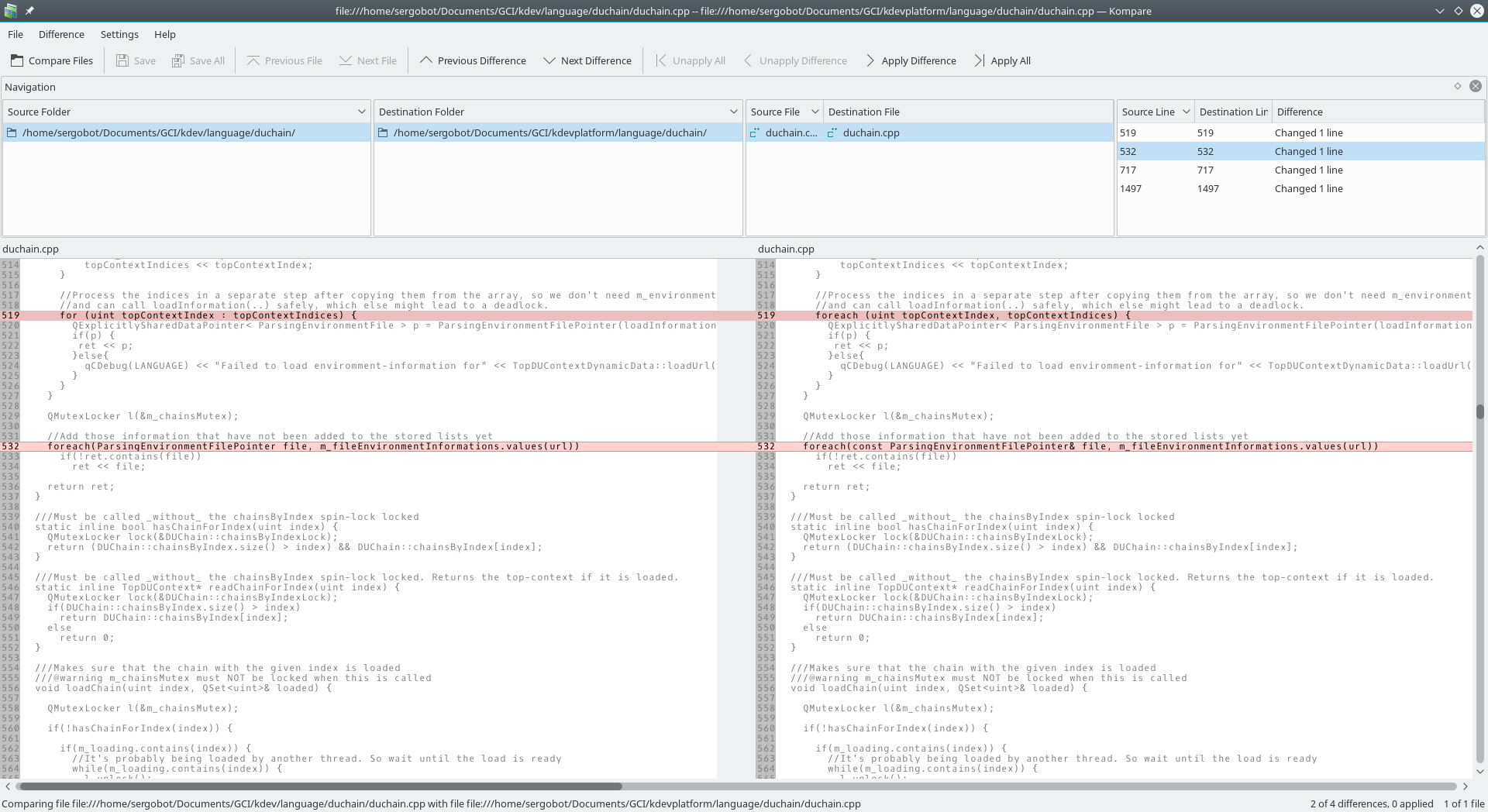
I just came across 'kompare'. It's a great way to track minor differences between plain text files. Very pretty, side-by-side, visualization of the changes.

The display uses 3 colours:
  1. Green - new text on the left
  2. Blue - new text on the right
  3. Red - changed text/area
See the wikipedia page for more details.

Friday, October 23, 2009

Using curl to POST data

I wanted to automate some load testing at work, this required sending some post requests to a running server in order to increase the amount of 'work' being done. I wanted to use 'curl' as it's a linux command line app and so very easy to incorporate in a script.

Anyway, this is how you post data with curl:

curl -d "param1=value1¶m2=value2" http://myhost.com/server.cgi

Friday, October 2, 2009

Inserting binary values in the mysql shell

I needed to insert some dummy values into a table which had a bit field as well as a blob field, both of which are "NOT NULL". You just need to have the 'b' prefix on the data, like so:


INSERT INTO faketable(blob1, name, bitfield) values(b'001011101', "Beeblebrox", b'1');


You can also print out the binary data in a way that's not going to ruin your terminal using the BIN(), OCT() and HEX() functions:


SELECT name, HEX(blob1), BIN(bitfield) from faketable;
+--------------------+--------------+----------------+
| name | HEX(blob1) | BIN(bitfield) |
+--------------------+--------------+----------------+
| Beeblebrox | 005D | 1 |
+--------------------+--------------+----------------+

Monday, September 14, 2009

R - percentiles

I just needed to find some percentile thresholds and thought that it'd be easy with R. Well, it is!

So, load the data

data = seq(0,1,0.01);

Then you can get quantiles like so:

quantile(data);

0% 25% 50% 75% 100%
0.00 0.25 0.50 0.75 1.00

and percentiles by using the vector argument to quantile (in this case I'm looking at the 0th to 1st percentile):

0% 0.1% 0.2% 0.3% 0.4% 0.5% 0.6% 0.7% 0.8% 0.9% 1%
0.000 0.001 0.002 0.003 0.004 0.005 0.006 0.007 0.008 0.009 0.010

Friday, September 11, 2009

screen

Ever lost a terminal which had an active job running? Ever wanted to check in on what you'd been doing from home *and* wanted or needed the session history as well?

'screen' is your friend. If you're starting work that's important or that you may want to check from another machine it's a real time-saver. Have a look at the man page for more details than you can shake a stick at.

I've only been using it for a little while, so the only caveat I've found so far is that I have to remember to give the sessions a reasonable name before I start them. Otherwise, if you've got a lot of sessions, it's a time waster trying to find the right one. The '-t' flag sets the title for the default shell; more importantly the '-S' flag sets the session title. I've been using the same string for both (will probably set up an alias to deal with the duplication soon).

e.g.

shell1> screen -t data_loading -S data_loading
shell2> screen -ls
There are screens on:
21802.data_loading (Attached)
20237.pts-10.hamilton (Attached)
1376.variance_analysis (Attached)
6639.pts-8.hamilton (Attached)
9881.cluster_jobs (Attached)
5 Sockets in /var/run/screen/S-paul.

You can see from the above listing that there are 5 sessions (all currently attached). There are two listings there with no session title and I have no idea what I'm doing in them... but for the other three it's obvious (at least to me).

Monday, August 31, 2009

Code formatting for blogger

This post is very out of date now - I recommend using GitHub and Gists for adding code to blog posts.

... older post below ...
I've been meaning to look into this for a while. I'd like to be able to insert nicely formatted code into posts.

I found the follwing blog post - getting-code-formatting-with-syntax-highlighting-to-work-on-blogger and figured I'd give it a try.

Unfortunately following the instructions in the above post didn't work for me and I had to waste some time on the project site to find out what to do. This post on puffyandmishu was very helpful. I ended up with the following code in my blogger template:

1. In the <head> tag:
<script language='javascript' src='http://alexgorbatchev.com/pub/sh/current/scripts/shCore.js'/>  
<script language='javascript' src='http://alexgorbatchev.com/pub/sh/current/scripts/shBrushCpp.js'/>
<script language='javascript' src='http://alexgorbatchev.com/pub/sh/current/scripts/shBrushBash.js'/>  
<script language='javascript' src='http://alexgorbatchev.com/pub/sh/current/scripts/shBrushJava.js'/>
<script language='javascript' src='http://alexgorbatchev.com/pub/sh/current/scripts/shBrushSql.js'/>
<script language='javascript' src='http://alexgorbatchev.com/pub/sh/current/scripts/shBrushPerl.js'/>
<link href='http://alexgorbatchev.com/pub/sh/current/styles/shCore.css' rel='stylesheet' type='text/css'/>
<link href='http://alexgorbatchev.com/pub/sh/current/styles/shThemeDefault.css' rel='stylesheet' type='text/css'/>


2. at the bottom of the <body> tag:
<script language='javascript'>  
SyntaxHighlighter.config.bloggerMode = true;
SyntaxHighlighter.all()  
</script>  


Let's test it out:

C - <pre class="brush:c">


int main(void)
{
    uint8_t i = 0;
    char c = 'a';
    while(1)
    {
        i++;
    }
}

Bash - <pre class="brush:bash">


for i in `ls *.c`;
  do echo $i;
done

Sql - <pre class="brush:sql">


SELECT name FROM mydb.test_table WHERE id IN (1,2,3,4,5);
INSERT INTO mydb.test_table VALUES(1) WHERE name = "test";

Java - <pre class="brush:java">


private static final class MyClass extends YourClass implements Cloneable
{
    public int mMyInt = 145;
    private String mString = "blarg";
    protected double mDouble = 23.45;

    public void main(String[] pArgs) throws Exception
    {
        System.out.println("Hi there");
    }
}

Perl - <pre class="brush:perl">


use warnings;
use strict;

my $i = 10;
for my $j (0 .. $i)
{
    print "This is line $j.  How lovely!\n";
}
warn "this does nothing.";


Line wrapping off <pre class="brush: plain; wrap-lines: false">


This is an example of a long line that shouldn't wrap.  Dwi eisio ddweud rhiwbeth yn Cymraeg ond dwi wedi anghofio popeth.  How long can we make these bars?


Now lets try it with Perl.
perl -F'\t' -lane 'print if $h{$F[0]}++;END{print "$_\t$h{$_}" for keys %h}' averyververververlongfilename.tsv

Friday, August 21, 2009

AVR delay_ms

When programming the AVR uC you have to remember that the delay_ms and delay_us functions will tie in the whole floating point library unless they are passed constants. This will always make the code too bloated to fit in anything less that 3K. So, it's right out for the ATtiny13 (1K Flash memory). I've been bitten by this twice now and the incidences were far enough appart that it took me 45 mins the second time to trace what was going on...

I was trying this:

delay_ms(delay);
if(i==0)
delay--;

but should have been increasing/decreasing the delay time by wrapping the delay call in a loop of variable length instead.